
What type of foundation does the structure have?
Select all that apply
Piers/Piles/Posts/Columns
Pile foundation
A type of open foundation consisting of concrete, wood, or steel structural elements driven or jetted into the ground or cast-in-place. Piles are relatively slender in comparison to their length, which usually exceeds 12 times their horizontal dimension. Piles derive their load-carrying capacity through skin friction, end bearing, or a combination of both.
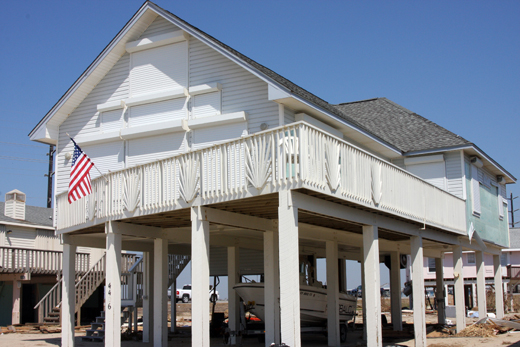
Storm panels, stilts and mitigation helped protect this home from high winds and storm surges in Galveston, TX, September 2008. Image by Robert Kaufmann/FEMA via Floodsmart.gov.
Pier foundation
A type of open foundation consisting of isolated masonry or cast-in-place concrete structural elements extending into firm materials. Piers are relatively short in comparison to their width, which is usually greater than or equal to 12 times their vertical dimension. Piers derive their load-carrying capacity through skin friction, end bearing, or a combination of both.
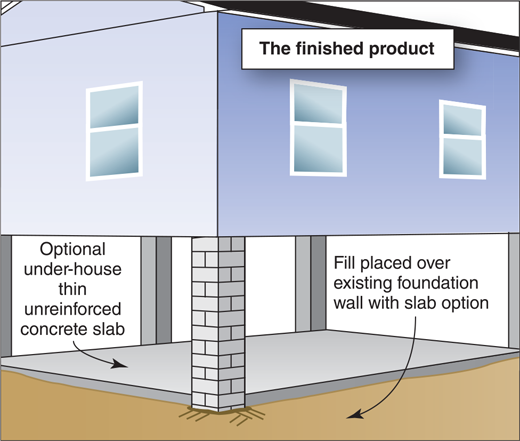
Illustration of how to elevate a basement or crawlspace foundation home on piers. Image by FEMA via FEMA P-312. Figure 5-13d.
Post foundation
A type of open foundation consisting of vertical support members set in holes and backfilled with compacted material. Posts are usually made of wood and usually must be braced. Posts are also known as columns, but columns are usually made of concrete or masonry.
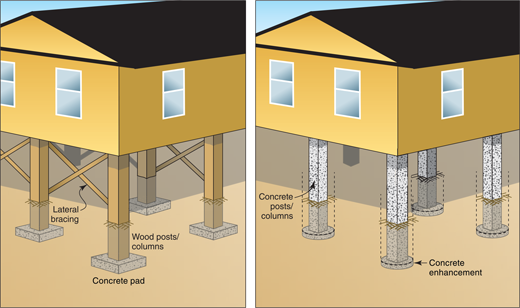
Illustration of homes elevated on post or column foundations. Image by FEMA via FEMA P-312. Figure 5-14.
Column foundation
A type of open foundation consisting of vertical support members with a height-to-least-lateral dimension ratio greater than three. Columns are set in holes and backfilled with compacted material. They are usually made of concrete or masonry and often must be braced. Columns are sometimes known as posts, particularly if they are made of wood.

Residential home elevated on columns. Photo courtesy of Randy Behm.
Crawlspace
Low space below the first floor of a house, less deep than a basement, typically with low masonry perimeter walls with interior piers supporting a wood floor. Often used to access pipes, ducts, and utilities. With this type of foundation, the lowest floor of a home is suspended above the ground on continuous foundation walls. Crawlspace foundations are prone to failure caused by erosion or scour because they are usually supported by shallow footings. Note, buildings on slab foundations do not have crawlspaces.

A home in a Sumner County, KS, floodplain is elevated on an attractively done crawl space with flood vents. Image by Steve Samuelson via Flickr; licensed under CC BY-NC-ND 2.0.
Basement
The National Flood Insurance Program defines a basement as the area of a building with its floor below ground level on all sides (44 CFR § 59.1). NFIP regulations do not allow basements to extend below the BFE except in dry-floodproofed, non-residential buildings. (Note: A “walkout basement,” which has a floor at or above ground level on at least one side, is not considered a basement under the National Flood Insurance Program.)
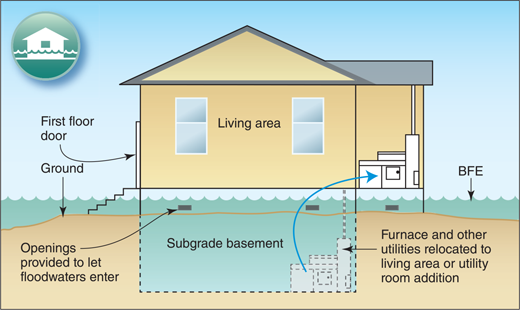
Illustration of a home with a wet floodproofed subgrade basement, which can help reduce flood damage but is not NFIP compliant. Image by FEMA via FEMA P-312. Figure 3-14.
Slab-on-Grade
Type of foundation in which the lowest floor of the home is formed by a concrete slab that sits directly on the ground. The slab may be supported by independent footings or integral grade beams. / A foundation with the first floor of poured concrete that sits directly on the ground.
 EN
EN  ES
ES