
Mitigation Strategy
Elevate the building on solid perimeter foundation walls
Overview
Elevation is a mitigation technique in which a structure, existing or new, is raised high enough that the lowest floor and all plumbing, electrical systems, and ductwork are at or above the Design Flood Elevation to prevent floodwaters from damaging the structure and its contents. There are generally five types of elevated foundations: on extended solid perimeter foundation walls (as described here), on piers, on posts, on columns, and on piles. Two variations to achieve elevation are: on engineered fill or by abandoning the lowest interior floor.

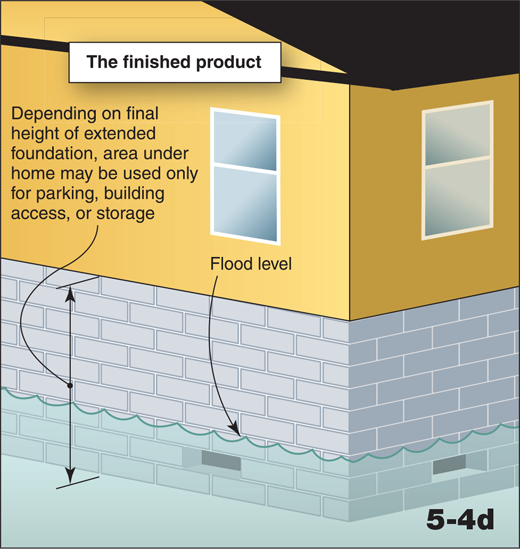
Depending on your structure’s foundation, location, and other factors, such as the likelihood of other hazards occurring, one elevation type might be a more effective strategy to protect your structure – and pocketbook – than another. The community’s floodplain management ordinance and local zoning codes should be consulted when deciding to what height to raise the structure, as additional elevation above the Base Flood Elevation may be required by local regulations. (Note that all portions of the building below the elevated first floor must be made of flood-resistant materials and cannot be used as living space – only for storage and access.)
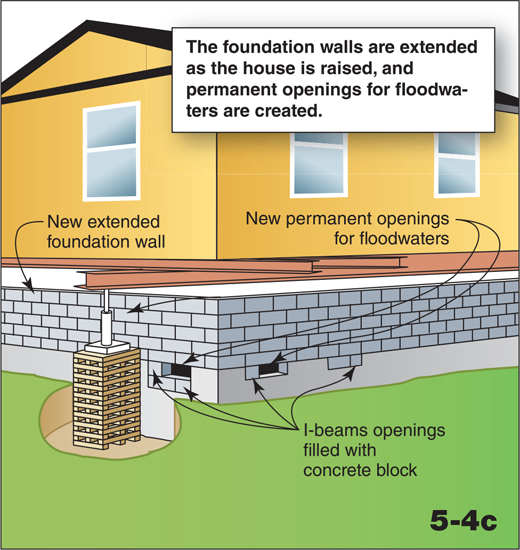
Elevation on solid perimeter walls involves extending existing solid perimeter foundation walls upward. This technique, also known as an extended foundation, results in the creation of a crawlspace where floodwaters flow under the structure through the crawlspace via a system of flood vents. It is most fitting for structures that only experience flooding of low to moderate depth and velocity, and works best for wood frame, masonry, and masonry veneer structures as well as new construction.

As with most elevation techniques, when elevating on solid perimeter foundation walls, the first step is to have the structure and the land on which it sits evaluated by a registered design professional for feasibility of success. Key questions are: Will it survive the lifting process? Is there enough space for the necessary equipment? Will the existing footing need to be reinforced or reconstructed? Is it worth the expense of lifting?
If the project moves forward, and once necessary permits are acquired, the structure is then lifted off its existing foundation to the appropriate height and secured using temporary supports while the new foundation is prepared. If in satisfactory condition, the existing footings and foundation walls may be added onto. If in poor condition, new concrete footings are poured. Whether using the existing foundation walls or a newly poured concrete footing, walls are typically extended upward using concrete masonry units (CMU) or cast-in-place concrete, with flood openings or vents built in to equalize the force of deep floodwaters acting against the walls in the event of a flood. Once the new foundation walls are set to the designed height, the structure is then lowered into place and secured with appropriate fasteners.
An annual inspection of all flood vents, the foundation, and fasteners is recommended in order to ensure that cracking, corrosion, or failure is not occurring.


Property Characteristics
Property Scale
Single Property
Real Estate Type
Single-family residence
Business
Government building
Foundation Type
Slab-on-Grade
Crawlspace
Basement
Property Location
Non-coastal
Past Flood Depth
Moderate
Shallow
Debris Flow Potential
No
Structure Condition
Fair-to-excellent condition
Implementation Factors
Annual Maintenance Required
Low
Action Required If Flood Is Imminent
No, Passive
Relative Cost
$$$$
$$$$$
Level of Effort
Professional
Next Steps:
- Consult with your local floodplain manager to determine the height to which you should elevate and what permits are necessary.
- Hire a registered design professional to help evaluate the building and building site for the feasibility of the project, and to prepare design plans for the necessary contractor cost estimates and work.
- Hire a professional house moving company to work with your contractor to coordinate the construction ofdesign your new foundation, provide details on the elevation process, and obtain required permits from your community’s building department.
- The house mover will work with utility companies to disconnect all utilities and plumbing prior to elevating the building.
- The house mover will remove obstructive landscaping, stairs, and landings, then temporarily elevate the building while the new foundation is constructed by your contractor.
- The house mover will lower the building onto the new foundation, secure it, then construct permanent access. All utilities and plumbing will be reconnected.
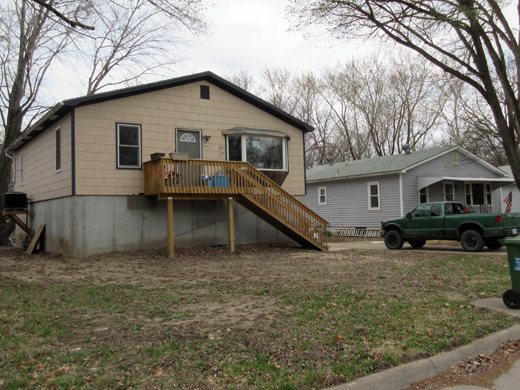
- Once the structure is elevated, new stairs, porches and landscaping can be added, if necessary.
Special Considerations:
- This mitigation option type is not recommended in areas with high velocity flooding, where water moves at more than 6 feet per second. If you do not know the projected flood velocity around your property, check with your local floodplain manager.
- Costs and difficulty increase as the dimensions and weight of the structure increase and impact the structure’s stability. Slab-on-grade structures are particularly risky to elevate as they have a much higher likelihood of failing and require additional steps to evaluate the likelihood of success and to complete the elevation process (see FEMA P-312 page 5-9 for more information). Any additions to a structure (exterior façades, attached garages, porches, wings, additions, and chimneys) must either be removed and lifted separately or braced to stay in place. The easiest type of structure to elevate is one that is single-story, rectangular, and wood-frame with a crawlspace; the hardest is one that is multi-story and masonry with a slab-on-grade foundation.
- If the existing building considered for elevation on solid perimeter walls contains a basement, it would need to be emptied of utilities and mechanical equipment, filled with sand, gravel or soil and capped with concrete or a vapor barrier. The resulting crawlspace from extending the foundation is required to be wet floodproofed, with enough flood vents. Any removed utilities or mechanical equipment would then be relocated above the design flood elevation, which is often a small addition to the building.
- You may be required to sign a non-conversion agreement stating any enclosed areas below the BFE will remain unfinished and restricted to specific limited use (i.e. vehicle parking, limited storage, and building access), and acknowledging that the restrictions have been recorded on the deed to the property; since the deed follows the property, future homebuyers will be informed of the restrictions.
If your building or structure is in less than fair condition, this mitigation option type is not recommended. The only mitigation option types recommended for structures in less than fair condition are acquisition, demolition, and the purchase of flood insurance or business interruption insurance. - Ensure compliance with all applicable National Flood Insurance Program (NFIP) requirements and local building codes. The NFIP sets minimum standards and allows individual communities to adopt their own additional or more stringent requirements via local floodplain management ordinances, regulations, and laws.
- If your building sustained substantial damage during a recent flood event, you may be required to bring it into compliance with NFIP and local floodplain management regulations.
- Be careful not to redirect water flow from your property onto another property. No adverse impact (NAI) floodplain management is an approach that ensures the action of any property owner, public or private, does not adversely impact the property and rights of others. NAI calls for any adverse impact caused by a project to be mitigated as part of the project. By following NAI principles, you can: prevent flooding from increasing or damaging others; see a reduction in flood losses over time; and avoid challenges and lawsuits over causing or aggravating a flood problem.
- Contact a local flood insurance representative to learn more and get a quote, if you do not already have flood insurance. (Most homeowner’s insurance policies do not cover flood damage.
- Renters and those who own specific types of property may be limited in which mitigation options they can undertake or have different requirements to which they must adhere. If you are a renter or own any of the following listed property types, click through to learn more: Renter; Unit in a multifamily residence; Manufactured home; Farm/ranch; Historic property; New construction.
Additional Resources
Reduce Flood Risk
https://www.reducefloodrisk.org/mitigation/elevate-the-building-on-solid-perimeter-foundation-walls/
Printed: 06/13/2026
 EN
EN  ES
ES