
Mitigation Strategy
Improve lot grading
Overview
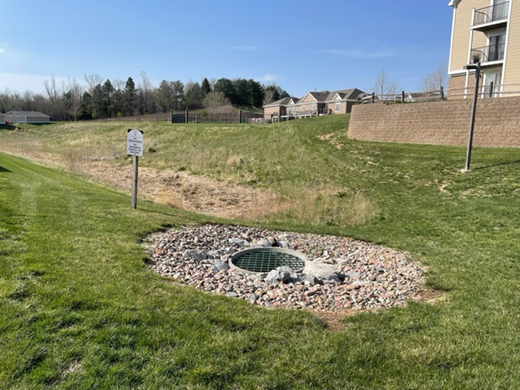
A properly graded yard should slope away from your building. Lot grading involves contouring your yard by building up sunken areas with fill, compacting existing or adding new backfill soil around your foundation, and digging small channels to reroute water away from the structure, among other strategies. Improving your lot’s grading can help protect your building from flooding, erosion, scour, and ponding water by redirecting water — whether floodwater, rainwater, or snow melt — away from any low points of entry, such as the foundation, doors and window wells, to the street and municipal stormwater infrastructure, like a drainage ditch, storm sewer or drainage swale.

Your home may be at risk of flooding due to improper grading if it was built in an at-risk area where water naturally collects — such as at the bottom of a hill or in a natural drainageway or floodwater retention area — or perhaps your yard has gradually changed over time due to: soil settlement; landscaping changes; the installation of a fence or swimming pool, or ancillary buildings; faulty eavestroughs and downspouts; or additions to your or your neighbors’ buildings, etc. It is important to make sure that your yard is properly graded to prevent flooding or ice buildup in your neighbors’ homes as well as your own. If you have a crawlspace, make sure not to backfill against the crawlspace wall or otherwise cause the crawlspace floor to end up below the fill level on all sides. Dirt and soil placed close to foundation walls should be graded to direct floodwater away from the building.
The greater the velocity or turbulence of the moving water, the greater the scour potential. Therefore, site grading is most effective as a flood protection method for buildings at risk of slow, shallow (less than three feet) flooding rather than those at risk of flash or deep flooding. By removing obstructions and restoring swales, you can improve your lot’s drainage and carry water away from your house to reduce your risk at a low cost.

Property Characteristics
Property Scale
Single Property
Neighborhood
Real Estate Type
Single-family residence
Business
Government building
Foundation Type
Crawlspace
Basement
Slab-on-Grade
Property Location
Non-coastal
Past Flood Depth
Moderate
Shallow
Debris Flow Potential
Yes
Structure Condition
Fair-to-excellent condition
Less than fair condition
Implementation Factors
Annual Maintenance Required
Low
Action Required If Flood Is Imminent
No, Passive
Relative Cost
$
$$
$$$
$$$$
Level of Effort
Professional
DIY
Next Steps:
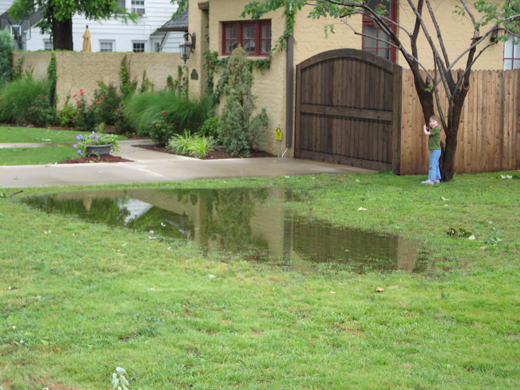
- Check your lot to determine how water flows or accumulates around your building. Does your yard slope away from or towards your building? Are there any potential trouble spots? Check everywhere, including under stairs, decks, and crawlspaces. The ideal time to do this is a few hours after a rainstorm. If you notice any pooling around or water flowing towards your building, you should check your backfill, contact your local floodplain management or building department. Note that water remaining in the yard for a few hours after a storm is to be expected.
- Check the backfill against your foundation wall. Is the soil that abuts the wall higher than the rest of the yard? If you notice that the backfill has settled and is at the same level or lower than the rest of the yard, you will need to fill it in with a solid, compactable soil (such as clay) so that there is a constant slope away from the foundation.
- Contact your local government’s floodplain management or building department. You will want to ask them about:
- Flooding on your property, including where stormwater infrastructure is located around your property so you know where to redirect your water responsibly;
- What local codes and ordinances you will need to make sure to follow when doing this work; and
- What types of permits you might need to do the work discussed.
- Contact a local landscaper to help regrade your lot in line with the requirements outlined by your local government. If you have the knowledge, you may be able to regrade your own lot; hiring a professional, however, is recommended.
Special Considerations:
- Ensure compliance with all applicable National Flood Insurance Program (NFIP) requirements and local building codes. The NFIP sets minimum standards and allows individual communities to adopt their own additional or more stringent requirements via local floodplain management ordinances, regulations, and laws. If your property is in a regulatory floodway, you may have limited to no ability to regrade your lot due to floodplain management restrictions.
- Be careful not to redirect water flow from your property onto another property. No adverse impact (NAI) floodplain management is an approach that ensures the action of any property owner, public or private, does not adversely impact the property and rights of others. NAI calls for any adverse impact caused by a project to be mitigated as part of the project. By following NAI principles, you can: prevent flooding from increasing or damaging others; see a reduction in flood losses over time; and avoid challenges and lawsuits over causing or aggravating a flood problem.
- Renters and those who own specific types of property may be limited in which mitigation options they can undertake or have different requirements to which they must adhere. If you are a renter or own any of the following listed property types, click through to learn more: Renter; Unit in a multifamily residence; Manufactured home; Farm/ranch; Historic property; New construction.
Additional Resource
Reduce Flood Risk
https://www.reducefloodrisk.org/mitigation/improve-lot-grading/
Printed: 04/16/2026
 EN
EN  ES
ES