
Mitigation Strategy
Reinforce basement walls to withstand hydrostatic and hydrodynamic pressure
Overview
A residential or nonresidential building located in the special flood hazard area (SFHA) that has a basement or crawlspace may need to have its basement walls reinforced to prevent hydrostatic and/or hydrodynamic pressure from compromising them. Hydrostatic pressure builds as floodwater in contact with foundation walls slowly increases in height. As the soil surrounding the building becomes saturated with floodwater, hydrostatic pressures grow more intense along with the increasing weight of the water. Hydrodynamic pressure is exerted when the water is in motion; whether from waves in a coastal area or from floodwaters flowing along a river or stream, the movement of water places additional pressure on foundation walls, particularly in the direction of the flow of water. Floodwater in motion or waves may also carry debris (logs, lumber, ice, etc.), which can collide with foundation walls.
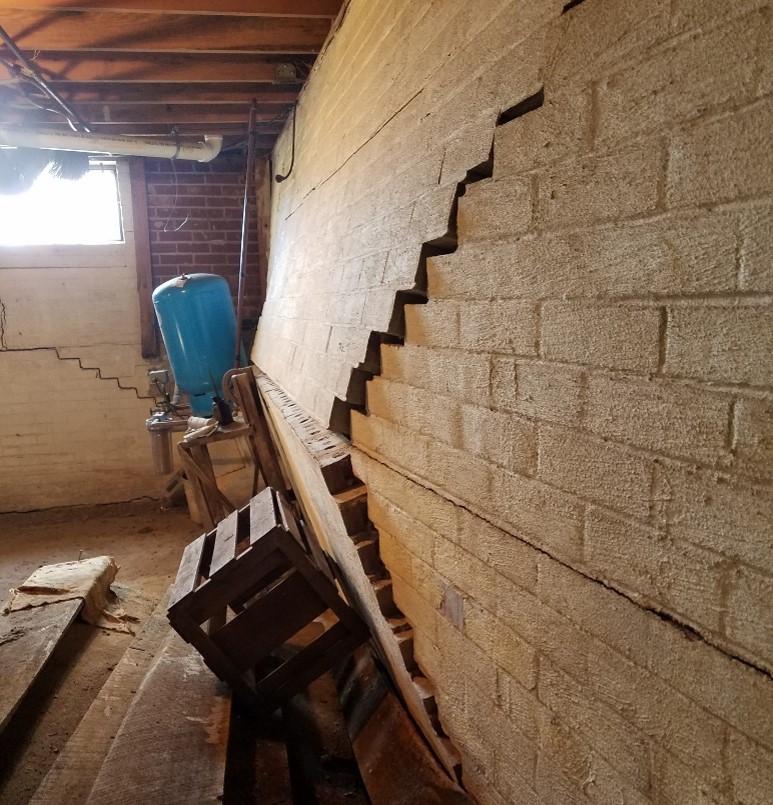
Water pressure or the impact of debris can cause damage that allows floodwater to seep into a basement or crawlspace. If seepage enters through the walls, the building’s foundation may crack, bow, or collapse, causing significant damage to the building and its contents, and posing a safety risk. Failure may be prevented by installing cross bracing connecting two parallel basement walls, adding vertical metal posts driven into the floor and attached to the wall(s) that need securing, or attaching anchor plates to the wall with rods located on the exterior of the foundation, holding the wall in place.
While reinforcing the foundation walls could prevent catastrophic failure of the foundation supporting the building, reinforcement alone will not prevent seepage of floodwater into the basement or crawlspace. To prevent seepage from occurring, additional dry floodproofing measures such as water-resistant sealants may be necessary. Note that the most effective flood risk reduction option would be to abandon the basement or crawlspace if all of the basement or crawlspace contents can be relocated.
While dry floodproofing nonresidential buildings may qualify for a discount in flood insurance rates, dry floodproofing a residential building does not (although it may prevent flood damage).
Property Characteristics
Property Scale
Single Property
Real Estate Type
Single-family residence
Foundation Type
Crawlspace
Basement
Property Location
Coastal
Past Flood Depth
Unsure
Moderate
Shallow
Deep
Debris Flow Potential
Yes
Unsure
Structure Condition
Fair-to-excellent condition
Implementation Factors
Annual Maintenance Required
Low
Action Required If Flood Is Imminent
No, Passive
Relative Cost
$$$
$$$$
$$$$$
Level of Effort
Professional
Next Steps
- Contact your local government to learn more about your property’s flood history and Base Flood Elevation, and to determine what federal, state and local permitting, code or ordinance requirements you will need to follow, before any work starts. If you are not sure who to talk to, check out our “who to contact” page. Your community’s floodplain management administrator also may be able to provide guidance as you search for a qualified engineer and/or contractor.
- Reinforcing foundation walls and mitigating floodwater seepage can be a very complex solution requiring detailed structural analyses. To ensure the proper solution is identified, hiring a qualified engineer is recommended.
- Once identified, hire a qualified contractor to install the solution. Make sure all necessary permits are obtained.
- Check with your local government to determine any specific requirements for the maintenance.
Special Considerations
- If your building or structure is in less than fair condition, this mitigation option type is not recommended. The only mitigation option types recommended for structures in fair to poor condition are acquisition, demolition, and the purchase of flood insurance or business interruption insurance.
- Ensure compliance with all applicable National Flood Insurance Program requirements and local building codes. The NFIP sets minimum standards and allows individual communities to adopt their own additional or more stringent requirements via local floodplain management ordinances, regulations, and laws. If your building sustained substantial damage during a recent flood event, you may be required to bring it into compliance with NFIP and local floodplain management regulations.
- If reinforcement of the foundation walls and seepage mitigation is considered a Substantial Improvement, you may be required to bring the building into compliance with NFIP and local floodplain management regulations. Your local floodplain administrator will be able to advise if this is the case.
- Create a disaster plan. Be aware of all actions you will need to take once you receive warning of an oncoming flood event — and how much time each action will take to complete. Actions could include constructing your sandbag barrier or installing flood shields. Annually, inspect all removable pieces to make sure they are in good condition — and you have all necessary parts. Make sure whoever is identified to complete each action in your disaster plan knows how to perform the action, is physically able, and will be onsite. Once everything is in place to protect your home, you should evacuate to higher ground.
- Renters and those who own specific types of property may be limited in which mitigation options they can undertake or have different requirements to which they must adhere. If you are a renter or own any of the following listed property types, click through to learn more: Renter; Unit in a multifamily residence; Manufactured home; Farm/ranch; Historic property; New construction.
Additional Resources
There is an additional cost to access this reference material.
There is an additional cost to access this reference material.
Reduce Flood Risk
https://www.reducefloodrisk.org/mitigation/reinforce-basement-walls-to-withstand-hydrostatic-and-hydrodynamic-pressure/
Printed: 06/19/2026
 EN
EN  ES
ES